

What to Do If an MCA Funder Threatens a UCC-1 Lien on Your Business Accounts

An MCA funder says it will file a UCC-1 lien on your business accounts unless you pay. For many business owners, that message arrives when payroll, rent, or daily ACH debits are already stretched thin.
A lien threat is serious, but it is not automatically the end of the road. Before reacting, it helps to understand what a UCC-1 filing does, what it does not do, and which steps are worth taking first.
Short answer: A threatened UCC-1 lien does not, by itself, generally freeze your bank account. It is a public notice of a claimed security interest. What happens next depends on your MCA agreement, your state's law, and how you respond.
What Does It Mean When an MCA Funder Threatens a UCC-1 Lien?
A UCC-1 is a financing statement that a creditor files with the state to give public notice of a claimed security interest in business assets. Many MCA agreements authorize the funder to file one, and some include broad lien language covering most or all business assets.
For a full explanation of how UCC liens work and how a UCC filing differs from the lien itself, see our complete guide to UCC liens. For the contract terms that often come with these filings, see the common risks of merchant cash advances.
Can a UCC-1 Filing Freeze My Business Bank Account?
Not automatically. A UCC-1 filing is a notice, not a court order. A bank freeze or levy generally requires another step, such as a court judgment or a separate arrangement involving your bank. Some funders also send notices to a business's customers or payment processors, and whether that is enforceable depends on the contract and applicable law.
The details vary by state and by agreement, so this table is a starting point and not a prediction.
8 Steps to Protect Your Business
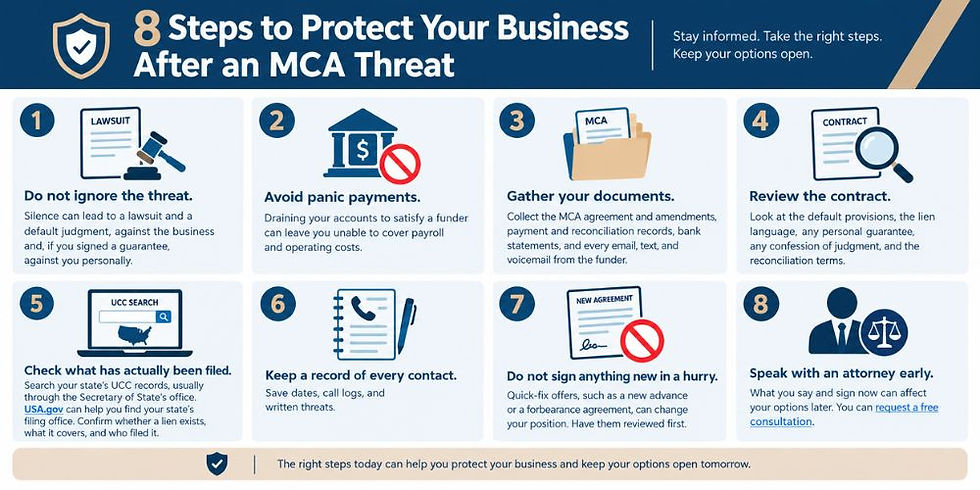
1. Do not ignore the threat.
If an MCA funder threatens a UCC-1 filing, lawsuit, or other collection action, do not assume the issue will resolve on its own. Ignoring notices can give the funder more time to pursue a default, lawsuit, or judgment against the business and, where applicable, the guarantor.
2. Avoid panic payments.
Do not drain your business bank accounts simply because a funder demands immediate payment. Paying a large amount under pressure could leave you without enough cash for payroll, rent, taxes, inventory, or other essential operating expenses. Review your actual cash flow before agreeing to additional payments.
3. Gather your documents.
Collect the original MCA agreement, amendments, payment history, reconciliation requests, bank statements, and communications with the funder. Emails, text messages, call records, and voicemails can also help establish what was promised, what payments were made, and how the funder responded to disputes or requests for reconciliation.
4. Review the contract.
Read the provisions dealing with default, UCC filings, collateral, personal guarantees, confession of judgment, payment obligations, and reconciliation. These terms can help determine what the funder claims it can do and whether its current actions are consistent with the agreement.
5. Check what has actually been filed.
A threat to file a UCC-1 is different from an actual UCC filing. Search your state's UCC records, typically through the Secretary of State or another designated filing office. Confirm whether a filing exists, identify the secured party, and review the collateral description to understand what the filing claims to cover. USA.gov can help you locate your state's government offices.
6. Keep a record of every contact.
Create a timeline of communications with the funder, including dates, phone calls, emails, payment demands, threats, and any documents you receive. Keeping everything in one place can make it easier to understand how the dispute developed and provide an attorney with the information needed to evaluate your situation.
7. Do not sign anything new in a hurry.
A funder may offer a new advance, payment arrangement, confession, or forbearance agreement to resolve the immediate dispute. These agreements can contain new obligations or change your existing position. Before signing, review the terms carefully and consider having an attorney evaluate the agreement.
8. Speak with an attorney early.
Early advice can help you understand your contractual obligations, evaluate the funder's claims, and determine which options may be available before the situation escalates. What you say, pay, or sign can affect your position later, so consider getting advice before responding to significant demands. You can request a free consultation.
Is the Funder's Conduct Lawful?
Not every collection tactic is lawful. The Federal Trade Commission has taken action against MCA companies for deceptive and abusive practices. A federal court entered a $20.3 million judgment against MCA operator Jonathan Braun for misleading small businesses and unlawfully seizing their assets.
In a separate case, Yellowstone Capital agreed to pay more than $9.8 million to settle FTC charges that it took money from business bank accounts without permission and misled businesses about the financing they would receive.
You can read the details in the FTC's RCG Advances case file and Yellowstone Capital case file. These cases do not mean your funder acted improperly. They show that MCA practices are subject to legal limits. If you believe a funder engaged in deceptive or abusive conduct, you can report it at ReportFraud.ftc.gov.
What Legal Issues May Be Worth Reviewing?

From an attorney's perspective, a lien threat is a reason to review the whole agreement, not just the UCC provision. Common questions include:
● Whether the transaction is a true purchase of receivables or functions more like a loan
● Whether the funder followed its own default and reconciliation terms
● Whether any confession of judgment is enforceable under your state's law
● How far a personal guarantee extends. A guarantee generally survives even if the business closes, as explained in what happens to business debt when you close your company
● Whether the lien filing and any notices to third parties were proper.
If bankruptcy is on your mind, see what happens to an MCA UCC lien in bankruptcy and our comparison of debt settlement vs. bankruptcy for business.
How Are These Situations Usually Resolved?
Depending on the facts, options may include:
● Negotiated settlement: a lump-sum or structured payoff for less than the claimed balance. Learn more about MCA debt relief.
● Restructured payments: terms based on the business's actual cash flow
● A broader debt strategy: where several advances or other obligations are involved, business debt settlement may address them together
● Legal action: where the facts support challenging the funder's conduct or the agreement itself
No outcome is guaranteed, and results depend on the agreement, the amounts owed, and applicable law.
How Is a UCC-1 Lien Removed After a Settlement?
Settling the debt does not automatically remove the public filing. The funder generally has to file a UCC-3 termination statement. In many states, the secured party must do this within about 20 days after receiving a written demand once the debt is paid, though the exact rule depends on your state's version of UCC Section 9-513.
It is usually wise to make the UCC-3 termination a written term of any settlement, then confirm in the public record that it was filed. Our guide to UCC liens explains how to request termination or challenge a filing.
If you plan to seek SBA financing later, note that SBA's rules on refinancing merchant cash advances changed on October 1, 2026. Check current requirements at SBA.gov or with an SBA lender.
Conclusion
An MCA funder's threat to file a UCC-1 lien is meant to create urgency. In most cases, the lien is a public notice and a pressure point, and the larger risks come from a lawsuit, a judgment, or a personal guarantee. Understanding the agreement, responding in an organized way, and getting legal advice early can help you avoid reacting out of panic.
Business Debt Counsel helps business owners across the United States review MCA agreements, address UCC liens and creditor claims, and evaluate business debt-relief options.
MCA UCC-1 Lien Threat FAQs
Can an MCA funder freeze my bank account with a UCC-1?
A UCC-1 filing alone generally does not freeze an account. A freeze or levy usually requires another step, such as a court judgment. The details depend on your agreement and state law.
Will a UCC-1 lien affect my credit or financing?
A UCC-1 is a public record that lenders can see, so it may make new financing harder. Whether it affects personal credit depends on any guarantee and any resulting judgment.
Can an MCA funder file a UCC-1 without telling me?
Many MCA agreements authorize the filing, so a funder may file based on the contract. Searching your state's UCC records can show whether a filing exists.
Am I personally liable if the funder files a UCC lien?
The lien is against business assets. Personal exposure usually comes from a personal guarantee or a judgment, so the guarantee language in your agreement matters.
How do I get a UCC-1 lien removed?
A lien is typically removed once the debt is paid or resolved and the funder files a UCC-3 termination. In some cases, the filing may also be challenged.


