

What Happens to Business Debt When You Close or Dissolve Your Company?

Closing a business is rarely a single decision. It's a series of them, and one of the most consequential is what happens to the debt left behind. Many owners assume that once the doors are locked, the balances owed to lenders, funders, and vendors close along with the business. That assumption is one of the most expensive mistakes an owner can make on the way out.
Whether the debt disappears, gets paid down, or follows you personally depends on how the business was structured, how it's wound down, and what kind of debt is involved. A merchant cash advance, a personally guaranteed loan, and unpaid payroll taxes do not behave the same way once a company closes.
Closing your doors is not the same as closing your liability
Closing means the business has stopped operating day to day. Dissolving is the formal process of ending its legal existence: notifying creditors, settling remaining debts, and filing dissolution documents with the state. The U.S. Small Business Administration lists filing dissolution paperwork with the state as a required step when closing an LLC or corporation.
An entity that stops operating but never dissolves is still alive as far as the state and its creditors are concerned. It can still be sued, it can still accumulate state fees and penalties, and it offers none of the protection an owner assumes is already in place. Owners who skip this step because "the business is effectively over" are often the ones who get an unpleasant surprise a year or two later.
What happens to LLC or corporate debt during dissolution
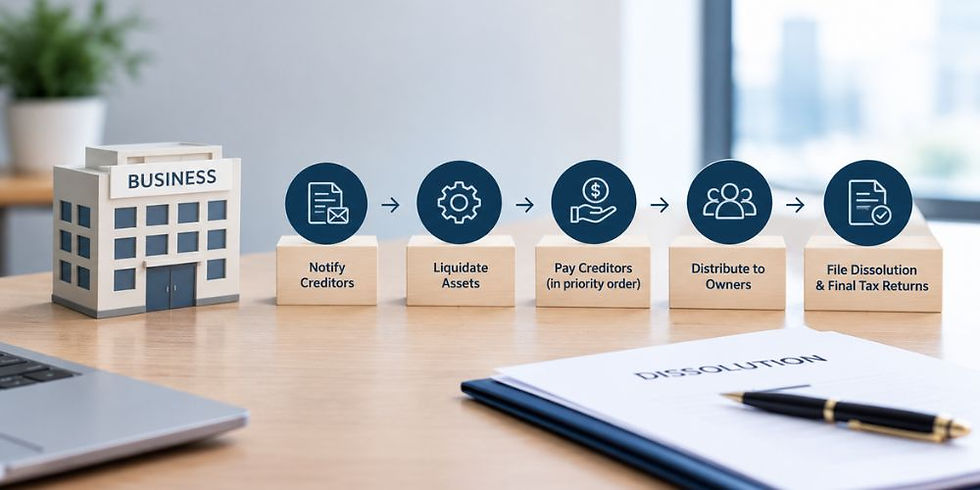
When an LLC or corporation dissolves properly, its remaining assets go toward paying creditors before anything is distributed to the owners. Secured creditors are generally paid first from the collateral tied to their debt, followed by other creditors under the state's priority rules. Only what's left can go to members or shareholders.
The order matters. Paying yourself or other owners while creditors sit unpaid is one of the fastest ways an otherwise properly formed LLC loses its liability protection in practice. A proper wind-up generally follows this sequence:
Notify known creditors of the dissolution
Liquidate remaining business assets
Pay creditors in order of legal priority
Distribute any remainder to the owners
File dissolution documents with the state and complete final IRS filings
How different business debts are treated when a company closes
Not every debt behaves the same way once a company closes. This is a general overview, and the details vary by state and by contract language.
Type of debt | Does closing or dissolving the entity end it? | Are you personally exposed? |
Vendor and trade debt | Paid from business assets during wind-up; any remainder generally stays with the entity | Generally no, unless personally guaranteed or the liability shield is pierced |
Bank or SBA loan with a personal guarantee | No. The guarantee is a separate obligation | Yes, as guarantor |
Merchant cash advance with a personal guarantee | No. The funder's claim against the guarantor continues | Yes, as guarantor |
Secured debt (equipment, inventory, receivables) | Lender can take the collateral; a shortfall may remain | Depends on guarantees |
Commercial lease | Landlord can claim unpaid rent and damages | Yes, if you guaranteed the lease |
Payroll trust fund taxes | No. Survives closure | Yes, through the Trust Fund Recovery Penalty |
When business owners stay personally liable after closing
Limited liability is conditional, not automatic. These are the situations where it most often fails:
Personal guarantees. A guarantee on a loan, lease, or merchant cash advance survives the business regardless of how the entity dissolves.
Commingled funds. If personal and business accounts were never really separated, a court can disregard the entity and hold the owner responsible directly.
Ignored formalities. Failing to maintain the entity properly weakens the argument that it was ever separate from you.
Pre-closing asset transfers. Moving assets out of the business shortly before closing to keep them from creditors can expose the owner to additional liability.
Why payroll tax debt is different from every other kind

Unpaid payroll taxes are the category of business debt that catches owners off guard most often. According to the IRS, when a business withholds income tax, Social Security, or Medicare from employee wages and doesn't pay those amounts over to the government, the Trust Fund Recovery Penalty can be assessed against any "responsible person" who willfully failed to do so. The penalty is personal and equals the full amount of the unpaid trust fund taxes.
It applies whether the business is an LLC, an S-corp, or a corporation, and it doesn't depend on the business still being open. Closing the company doesn't make it go away. The IRS also requires a final return and final employment tax filings when a business closes, and the account isn't closed until those are complete.
Bankruptcy does not work the same way for a business as it does for a person
If a business owes more than it owns, dissolution alone may not resolve much, and bankruptcy sometimes enters the conversation. According to the U.S. Courts, an individual who files Chapter 7 receives a discharge of remaining debts, but a corporation or partnership does not. A business Chapter 7 liquidates the entity's assets and distributes the proceeds to creditors. It doesn't wipe the slate clean the way it can for a person.
That distinction matters for planning. If personal guarantees are involved, the choice between a negotiated settlement, formal dissolution, and bankruptcy should be made with the actual numbers in front of you. For a closer comparison, see our guide on debt settlement vs bankruptcy for business.
The mistakes that turn a clean close into a personal problem
A few decisions show up again and again in cases that go wrong:
Paying owners or insiders before creditors are settled
Assuming a business that stopped taking customers doesn't need a formal dissolution
Ignoring a demand letter or lawsuit because the business "doesn't exist anymore." Many states let creditors pursue a dissolved entity for a set period, and some allow it to be revived so a claim can be brought
Overlooking payroll and sales tax obligations because they don't feel like ordinary debt
None of these are unusual. Closing a business is stressful, and the legal sequencing isn't something most owners have had to think about before.
The right way to approach a business closing with debt on the books
Before any decisions are made, get a full picture of what's owed, what's secured, what's personally guaranteed, and what's tied to tax obligations. Review every loan and lease for guarantee language or judgment clauses that outlive the business. Then choose between a negotiated wind-down, formal dissolution, and bankruptcy based on the real numbers.
Business Debt Counsel works with owners making exactly this decision, particularly where merchant cash advances, personal guarantees, or aggressive creditor pressure are part of the picture. The goal is to settle what needs to be settled, protect what can be protected, and make sure the business's last chapter doesn't become the owner's next problem.
Closing a business can feel like the finish line. Handled the wrong way, it's the starting point for a new set of problems the owner didn't expect to still be carrying.
Note: The content on this blog provides general information and should not be relied upon as legal advice. Every situation is different; speak with a qualified attorney to get advice tailored to your needs.


