

A Complete Guide to UCC Liens

A UCC lien is a legal claim that gives a lender rights over a business’s assets as collateral for a loan.
It can limit your ability to get funding, restrict asset usage, and create challenges when applying for new financing.
Many business owners only realize the impact of a UCC lien when a loan gets denied or cash flow becomes restricted.
In this guide, you’ll learn how UCC liens work, how they affect your business, and how to remove or deal with them effectively.
What Does UCC Mean and What Are Liens?

The term UCC (Uniform Commercial Code) refers to a set of laws in the United States that standardize how business loans and secured transactions are handled across all states.
A lien is a legal claim a lender places on a borrower’s property or business assets as security for a debt. It gives the lender the right to recover value from those assets if the borrower fails to repay.
A UCC lien combines both concepts. It is a legal claim filed under the Uniform Commercial Code that allows a lender to secure an interest in a business’s assets—such as equipment, inventory, or receivables—until the debt is fully paid.
While a UCC lien does not transfer ownership, it restricts how a business can use or leverage its assets, especially when applying for new financing.
In practice, once a UCC lien is filed, it becomes part of the public record. Other lenders can see it, which may:
Reduce approval chances for new loans
Require lien payoff or subordination before funding
Signal higher financial risk to creditors
This is why UCC liens are closely reviewed by lenders before approving new business financing.
How a UCC Lien Works in Business Financing
A UCC lien functions as a public notice to creditors and other lenders. Once filed, it becomes searchable in state records, signaling that certain business assets are pledged as collateral.
This impacts future lending. Lenders may:
● Require subordination agreements
● Offer funding under stricter terms
● Deny financing until the lien is resolved
Merchant cash advance agreements often include broad lien provisions, which can restrict operations and future borrowing. These risks are explained in our guide on common risks of merchant cash advances every business owner should know.
UCC Lien Enforcement and Consequences
UCC lien enforcement occurs when a borrower defaults. Creditors may exercise rights over pledged collateral, which could include accounts receivable, equipment, or other business property.
These actions must comply with UCC rules, including proper notice and commercially reasonable procedures. From an attorney’s perspective, errors in enforcement or filing can provide grounds for challenge.
Merchant Cash Advance Lien and Risks
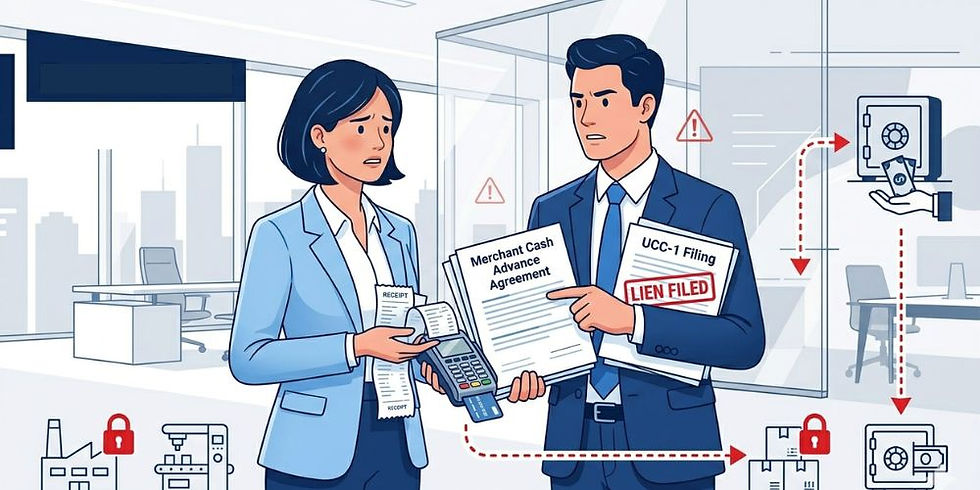
A merchant cash advance lien is one of the most frequently encountered UCC filings in business debt cases. These liens are often broad in scope and designed to secure the lender’s position immediately.
Common risks include:
● Blanket liens covering all business assets
● Reduced eligibility for additional financing
● Conflicts between multiple lenders
● Cash flow disruption tied to repayment structures
From a legal standpoint, the issue is not just the presence of the lien—but how broadly it is written and how it interacts with other obligations.
UCC Lien Priority Rules and Why They Matter
Priority determines which creditor has the first claim to assets if a dispute or default occurs.
In general, the first creditor to file a UCC lien holds priority. However, multiple filings, lender agreements, and procedural errors can complicate this order.
This becomes particularly important when businesses take on multiple funding sources, as conflicts between creditors can delay resolution and increase financial pressure.
UCC Filing Statement vs UCC Lien: Understanding the Difference

A UCC lien and a UCC filing are closely related but serve different purposes in business financing. Understanding the distinction is important, especially when reviewing loan agreements or resolving lien issues.
Feature | UCC Lien | UCC Filing (UCC-1) |
Definition | Legal claim on business assets | Public record of that claim |
Purpose | Secures lender’s interest in collateral | Notifies other lenders of the lien |
Created By | Loan or financing agreement | Filed with Secretary of State |
Visibility | Not directly visible unless filed | Publicly searchable record |
Legal Role | Gives lender rights in case of default | Establishes priority among creditors |
Impact on Business | Limits asset usage and borrowing ability | Affects how other lenders view your business |
Removal | Ends when debt is paid or resolved | Must be terminated through filing |
How to Remove or Challenge a UCC Lien
Addressing a UCC lien requires more than simply paying off a balance. In some cases, liens remain active due to administrative issues or disputes.
Businesses may need to:
● Request a termination filing from the creditor
● Identify filing errors
● Challenge the lien’s scope or validity
This is one area where legal strategy plays a direct role in outcome, particularly when lenders are unresponsive or enforcement is ongoing.
When to Consult a UCC Lien Lawyer
While not every lien requires legal action, certain situations call for professional review.
You may need legal guidance if:
● A lien appears unexpectedly
● Financing is denied due to an existing lien
● Multiple creditors are involved
● Enforcement actions have begun
From an attorney’s perspective, early review can often identify risks before they develop into disputes.
Conclusion: Legal Awareness Is Key
A UCC lien is a foundational part of secured business lending, but its impact is often underestimated.
Understanding how liens work, how they are enforced, and how they interact with merchant cash advance agreements allows business owners to make more informed decisions.
Many of the challenges businesses face, whether it’s enforcement, account restrictions, or removal, stem from a lack of clarity at the outset.
Business Debt Counsel works with businesses across the United States to analyze UCC liens, address MCA-related concerns, and guide clients through complex debt situations with a clear legal perspective.
FAQ:
1. What is a UCC lien in simple terms?
A UCC lien is a legal claim that a creditor places on a business’s assets to secure repayment of a debt. It does not transfer ownership but gives the lender rights over those assets if the borrower defaults.
2. How does a UCC lien affect my business?
A UCC lien can limit how your business uses its assets. It may make it harder to obtain additional financing, sell assets, or restructure debt, as lenders will see that your assets are already pledged as collateral.
3. Can a UCC lien prevent me from getting another loan?
Yes, in many cases. Lenders often review existing UCC filings before approving funding. An active lien may result in stricter terms, a request for subordination, or even denial of the loan.
4. Can a UCC lien be removed?
Yes, a UCC lien can be removed once the debt is fully paid, or through a termination filing by the creditor. In some cases, it may also be challenged if there are errors or legal issues with the filing.
5. Do all business loans have a UCC lien?
Not all, but many secured business loans and merchant cash advance agreements include UCC liens. The scope of the lien depends on the terms of the financing agreement.


